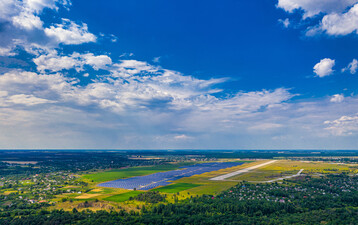
Technical and Commercial Viability Study for Solar PV Systems within the Airfield of Changi Airport
Changi Airport Group

Exploring the next frontier of airport solar deployment
airsight led a multidisciplinary technical and commercial viability study for Changi Airport Group to assess the potential deployment of solar photovoltaic systems within selected areas of the Changi Airport airfield. The study examined how airfield solar PV can be evaluated in a safety-critical airport environment, considering aeronautical safeguarding, airport operations, PV technology, commercial feasibility, biodiversity and wildlife management, flood risk, local implementation conditions and stakeholder coordination.
For airsight, leading such a study at Changi Airport is a significant reference project. Changi is widely recognised as one of the world’s most prominent and innovative hub airport environments. Taking responsibility for a feasibility study in this context underlines airsight’s ability to combine aviation safety expertise, sustainability consulting and complex stakeholder management for internationally relevant airport infrastructure projects.
The study was positioned within Singapore’s broader aviation decarbonisation agenda: The Singapore Sustainable Air Hub Blueprint identifies increased solar power deployment across airport facilities as one of the airport-domain measures to reduce emissions from airport operations. In this context, Changi Airport Group explored how renewable energy potential could be assessed beyond conventional rooftop spaces and within the operationally sensitive airfield environment.
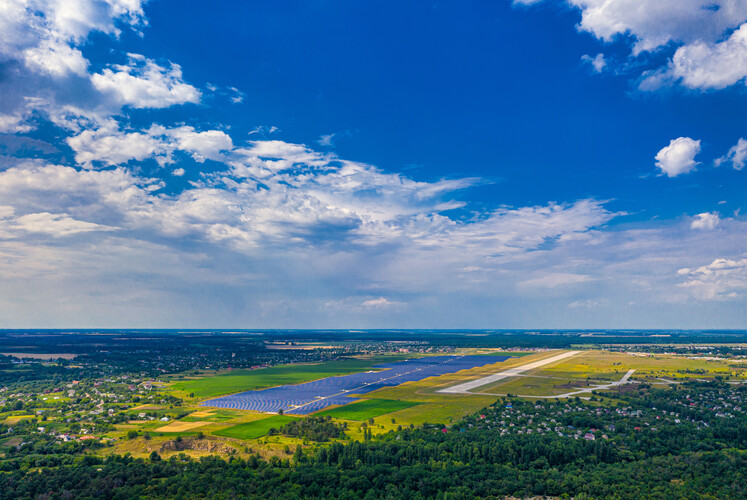
Project motivation: renewable energy in a safety-critical airport environment
Solar PV represents an important renewable energy opportunity for airports, particularly in land-constrained environments where available space must be used carefully and efficiently. However, airfield solar PV deployment is fundamentally different from a conventional ground-mounted solar project. Any potential PV concept must be compatible with aviation safety, airport operations, long-term maintainability and future airport development.
Unlike standard solar projects, airfield PV concepts must be evaluated against airport-specific constraints. These include obstacle limitation requirements, aircraft and vehicle operations, glint and glare effects, safeguarding of communications, navigation, surveillance and meteorological systems, emergency access, security requirements, wildlife hazard management, drainage, climate and flood resilience and the ability to construct and maintain systems without disrupting airport operations.
The feasibility study therefore provided a structured basis for decision-making. Rather than focusing only on theoretical energy generation potential, it assessed under which conditions solar PV systems could be considered in an operational airfield environment while maintaining safety, resilience and operational continuity.
Multidisciplinary project team
The study was delivered by an international consortium combining aviation-specific, technical, environmental and local implementation expertise. airsight acted as the project lead and integrated the specialist workstreams into one coherent feasibility assessment.
- airsight Singapore Pte. Ltd. & airsight GmbH: Project lead; aeronautical considerations; project and stakeholder management
- Dornier Group (Dornier Consulting International / Dornier Suntrace): Solar PV technical and commercial assessment
- Birdstrike Management Ltd. UK: Biodiversity, wildlife and fauna assessment
- IPS – Ingenieurgesellschaft Prof. Sieker: Flood risk assessment
- Energetix Pte. Ltd.: Implementation support and local PV partner in Singapore
This structure allowed the team to address solar PV not as an isolated energy project, but as an integrated airport infrastructure topic requiring aviation safety, environmental, technical, commercial and implementation perspectives.
Methodological approach
The viability study followed a phased and milestone-based methodology. Its purpose was not to promote a predefined solution, but to systematically assess whether, where and under which conditions solar PV systems could be considered within the airfield environment.
1. Airfield zoning and suitability screening
Potential areas were reviewed against aviation, regulatory, operational, environmental and technical criteria. The zoning methodology helped distinguish areas with clear restrictions from areas requiring more detailed assessment due to operational interfaces, infrastructure proximity or environmental sensitivities.
2. Aeronautical considerations and safety assessment
airsight led the aeronautical assessment, focusing on the compatibility of potential solar PV systems with safe airport operations. This included airport safeguarding, access and maintenance requirements, emergency response considerations, glint and glare, CNS/MET safeguarding and the need to maintain safe aircraft and vehicle operations.
3. Solar PV technical and commercial assessment
The technical and commercial workstream examined PV technology options, system configuration, installation conditions, electrical and structural considerations, maintainability, durability, energy yield methodology, lifecycle cost principles and commercial implementation models.
4. Biodiversity, fauna and wildlife assessment
The biodiversity and wildlife workstream assessed how solar PV systems could interact with the existing airfield environment, habitats and fauna. In an airport setting, ecological considerations must be evaluated together with with wildlife hazard management and impacts on fauna and flora.
5. Flood risk and drainage assessment
In light of climate resilience challenges the study considered how potential PV installations could interact with surface water management, runoff patterns, drainage infrastructure and flood resilience requirements.
6. Implementation planning and stakeholder coordination
The final workstream considered how viable concepts could be translated into an implementation-oriented framework, including phasing, constructability, operational coordination, permitting interfaces, local implementation conditions and potential trial or pilot approaches.
A significant reference for airport sustainability consulting
The project demonstrates the importance of assessing airport solar PV deployment through a multidisciplinary aviation lens. In an airfield environment, technical potential alone is not sufficient. A robust feasibility assessment must balance renewable energy opportunities with aviation safety, operational continuity, wildlife management, environmental performance, flood resilience, commercial viability and implementation practicality.
For airsight, the project is also an important demonstration of trust and capability. Being entrusted with the lead role for a study of this relevance at Changi Airport highlights airsight’s position as a specialised aviation consultancy able to manage complex sustainability projects at high-profile international airports. The project combines exactly the capabilities increasingly required by airport operators worldwide: sustainability strategy, aeronautical safety, operational feasibility, environmental risk assessment and implementation-oriented project management.
By leading the consortium and integrating the different specialist disciplines, airsight supported Changi Airport Group with a structured methodology for evaluating solar PV opportunities in one of the most demanding airport environments. The project underlines how airports can approach renewable energy deployment in a way that is technically sound, commercially informed, environmentally responsible and fully embedded in the operational reality of aviation.
Frequently asked questions
What was the purpose of the study? To assess the technical and commercial viability of solar PV systems within selected areas of the Changi Airport airfield, while considering aeronautical safety, regulatory compliance, airport operations, PV technology, biodiversity, wildlife, flood risk and implementation requirements.
What was airsight’s role? airsight led the study and was responsible for aeronautical considerations, project management and stakeholder management.
Why is airfield solar PV complex? Because solar PV systems in an airfield must be compatible with aviation safety, obstacle limitations, aircraft and vehicle operations, glint and glare, CNS/MET systems, wildlife hazard management, flood resilience, security and maintenance access but also solar PV related technical constraints.
Which disciplines were involved? Aeronautical safety and compliance assessments, solar PV technical and commercial assessment, biodiversity and wildlife assessment, climate resilience and flood risk assessment, local implementation planning and stakeholder coordination.
Key Facts