Offshore Wind Energy and Aviation in Europe
Contact Consulting Department

1. Introduction: Offshore Wind as an Integrated Infrastructure System
Offshore wind energy has developed in Europe, particularly in the North Sea, into a key pillar of the energy transition. With ambitious expansion targets of up to 300 GW of offshore wind capacity by 2050, a dynamically growing energy sector is emerging with fundamental impacts on infrastructure and operational concepts.
At the same time, offshore wind is increasingly developing into an integrated system in which energy infrastructure, maritime logistics and aviation are closely interlinked. As distances from the coast increase, traditional supply concepts based on ship transport are reaching operational and economic limits.
Helicopter operations are therefore gaining considerable importance and are taking on a key role in crew change, maintenance and emergency response.
The central challenge lies in operating these complex offshore systems efficiently and in compliance with regulations under increasing safety requirements. Solution approaches lie in particular in the early integration of aviation-specific requirements into planning, design and operations, as well as in the continuous technical and regulatory support of such systems.
Specialised consulting and engineering service providers such as airsight support the integration of aviation-specific requirements into offshore projects, starting from early concept studies through to operational implementation and regulatory support.
2. Spatial Development as the Starting Point of Offshore Aviation
2.1 Germany and International Allocation Models
The expansion of offshore wind energy is closely linked to national and international planning mechanisms. In Germany, the Site Development Plan of the Federal Maritime and Hydrographic Agency defines the spatial and temporal development, while international models establish the framework conditions for European expansion.
These systems not only determine energy generation but also decisively define how offshore structures can later be accessed and operated.
A central challenge is that aviation-specific aspects are often only taken into account in later project phases. This can lead to operational restrictions or make subsequent adjustments necessary.
The solution approach lies in the early integration of aviation studies, obstacle analyses and logistical concepts already in the planning phase.
In this context, experienced aviation-specific consulting companies provide support in carrying out aeronautical studies, obstacle assessments, and the development of integrated aviation concepts in order to identify and avoid potential conflicts already in early planning phases.
2.2 Further Reference Markets: Europe as a Differentiated Planning System
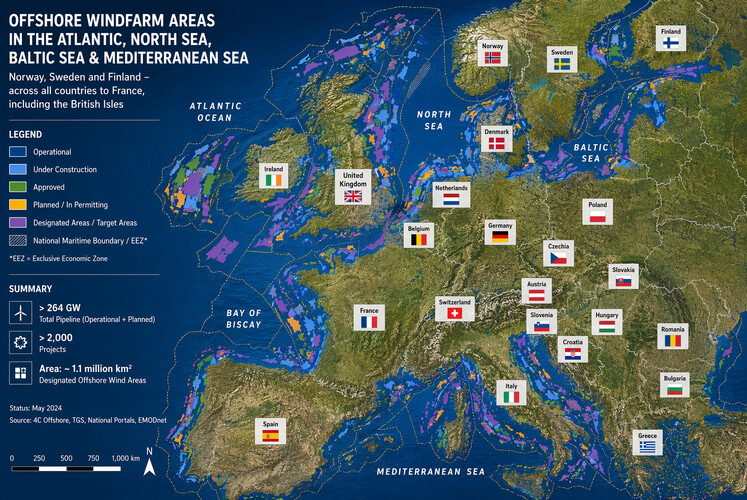
In addition to Germany, other European markets show increasing divergence in spatial development, while at the same time relevance for offshore aviation is growing.
United Kingdom
The United Kingdom relies on a strongly centralized site allocation model through The Crown Estate, a state organization responsible for the administration of large parts of the seabed around England, Wales and Northern Ireland. As part of several so-called “Leasing Rounds,” i.e. structured allocation procedures for offshore areas, six project areas with a total capacity of around 8 GW were recently allocated.
This model is characterized by the fact that, although the state defines and allocates the areas, the detailed project development largely remains with the developers. This results in large-scale offshore clusters with a high degree of planning certainty at the strategic level, but with a certain degree of flexibility in the specific design of the projects.
For aviation, this means stable framework conditions with regard to location and expansion path. At the same time, however, requirements increase due to greater distances from the coast as well as increasing operational intensity within such clusters, particularly with regard to coordinated approach procedures and the integration of several helicopter operations in a limited airspace.
Norway
Norway is pursuing an innovation-driven approach, particularly in the area of floating offshore wind, in which wind turbines are not installed on fixed foundations due to great water depths, but on floating platforms. This technology represents a fundamental difference from conventional offshore wind farms and opens up new site potential in deep-sea areas.
The example of the Utsira Nord project shows a division into several project areas that are allocated not primarily on the basis of financial criteria, but on qualitative aspects such as innovation, technical feasibility and sustainability. This allocation system specifically promotes technological advancement and project-specific solutions.
For aviation, this creates new challenges, as floating structures do not offer fully standardized geometric and operational framework conditions. Dynamic movements of the installations, different platform concepts, as well as a lack of comparative values, lead to increased requirements in the design of winching operation areas, flight procedures and safety assessments.
Netherlands
The Netherlands works with a highly structured offshore wind roadmap approach in which clearly defined wind energy areas such as Borssele, Hollandse Kust, IJmuiden Ver and Nederwiek are established. This approach is based on long-term overall state planning in which the sites are comprehensively investigated, technically prepared and coordinated with grid connections and permitting frameworks before the tendering process.
This centrally defined site structure enables very precise control of project development, since key risks and uncertainties are already reduced in advance. At the same time, however, this high planning density leads to the need to integrate existing offshore structures, such as platforms from the oil and gas sector, more strongly into the new spatial planning.
A concrete example is the adaptation of planning in the Nederwiek area, in which the expansion was modified in such a way that the safe helicopter access to an existing offshore platform remains ensured. This makes it clear that spatial development and aviation can no longer be considered separately, but must already be jointly taken into account at an early stage in an integrated planning system.
France
France uses a strongly tender-driven model in which individual offshore areas are allocated as part of auction rounds (Appels d’Offres, AO). These procedures define concrete project areas, which are then developed by the successful bidders.
Examples of this are the AO7 (Oléron) and AO8 (Centre Manche) projects, each of which represents large-scale offshore developments with an output of up to 1.5 GW and is also increasingly located further from the coast.
The increasing size and distance of these projects lead to rising requirements for offshore logistics and aviation, particularly with regard to range and deployment planning for helicopter operations. At the same time, delays and complex approval procedures in the past have shown that site-specific challenges have direct effects on economic feasibility and therefore also on the planning of aviation concepts.
Denmark
Denmark combines classic site allocation with large-scale, system-oriented infrastructure approaches. Offshore wind areas such as North Sea Mid, Hesselø and North Sea South with a total output of around 2.8 GW have currently been put out to tender, embedded in an overarching energy policy expansion path.
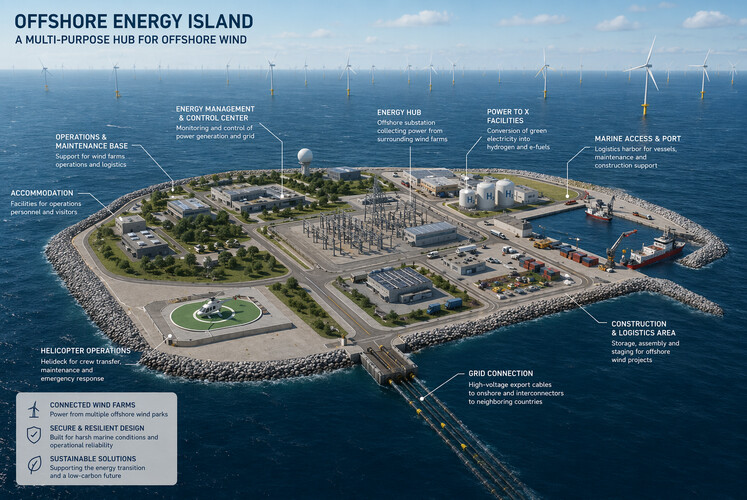
Particularly noteworthy is the concept of the so-called Energy Island, in which offshore wind farms are interconnected via central, artificially created nodes. These energy islands serve as collection and distribution points for electricity and, in perspective, also for power-to-X technologies.
For aviation, this for the first time creates clearly structured offshore operational spaces in which several wind farms, platforms and logistics systems are bundled together. On the one hand, this increases the efficiency of operational processes, but at the same time it leads to higher requirements for airspace structuring, traffic coordination and safety management.
Finland
Finland has created a structured regulatory framework for offshore wind with a new law on the use of the exclusive economic zone (EEZ), which particularly addresses development outside territorial waters. This law stipulates that the government identifies suitable areas and then allocates them competitively.
Several large-scale offshore areas, particularly in the Bothnian Sea and the Gulf of Bothnia, are currently being investigated and prepared for future developments. These regions are characterized by comparatively low pre-existing infrastructure burdens and large site potentials.
For aviation, this early planning approach is particularly relevant, because aviation aspects can already be taken into account in the area selection phase. This creates the possibility of making future offshore operations more efficient and less prone to conflict from the outset.
Sweden
Sweden is pursuing a spatial-planning approach through so-called maritime spatial plans, which coordinate the use of maritime areas in a structured way. These plans define large-scale usage zones in which offshore wind energy, shipping, nature conservation and other interests are coordinated with one another.
Current drafts provide for up to 23 energy areas for offshore wind, which could enable considerable expansion potential with annual electricity production of up to 120 TWh. These are less concrete individual projects than strategic development spaces.
This approach offers a high degree of flexibility for future use, but at the same time it leads to complex coordination processes between different sectors. For aviation, this means in particular increased requirements for airspace design, obstacle analyses and the integration of flight operations into a multifunctional offshore environment.
2.3 Tenders and Market Dynamics
Despite its long-term growth path, the offshore wind industry continues to show pronounced short-term market fluctuations. These arise in particular from increasing investment and financing costs, global supply chain bottlenecks, as well as adjustments to national tendering and support mechanisms.
In practice, this leads to delays in project decisions, adjustments to tender rounds or, in individual cases, even to a lack of bids. These developments have a direct impact on the timing of the implementation of offshore projects and therefore also directly influence the planning of offshore aviation.
For aviation stakeholders, this creates the challenge of adapting operational capacities—in particular fleet availability, base concepts and personnel planning—to an increasingly volatile project landscape. At the same time, uncertainty increases with regard to the actual utilization of aviation resources over the project life cycle.
A key solution approach therefore lies in the development of scalable and modular operating models that can react flexibly to project shifts. In addition, close interlinking between offshore project development and aviation-specific planning is becoming increasingly important in order to establish robust and adaptable access concepts for offshore structures at an early stage.
To minimize these risks, specialized service providers support through the development of flexible aviation operating models, the assessment of site dependencies, as well as early coordination between project developers, aviation operators and approval authorities.
3. Maritime and Air-Supported Supply Structures in the Offshore System
The transition from spatial development to operational implementation is shown in particular in the way offshore wind farms are supplied and operated. As the size and distance of projects increase, the focus is no longer on individual transport solutions, but on integrated logistics concepts.
This creates a system in which maritime and air-supported supply structures are closely interlinked and complement one another. The challenge lies in combining these two systems efficiently while at the same time meeting rising requirements for safety and availability.
This includes in particular the analysis and optimization of offshore logistics concepts as well as the safe and regulation-compliant integration of helicopter operations into existing maritime operating structures.
3.1 Role of Service and Supply Vessels
In addition to fixed offshore structures, maritime units are a central component of offshore logistics. Modern service and supply vessels take on:
- Transport of personnel and equipment
- Maintenance support directly at the installations
- Emergency and standby functions
A key aspect is that helicopter operations are not limited exclusively to fixed installations. Offshore helidecks are installed and operated not only on platforms but also on vessels according to recognized standards such as CAP 437.
This creates hybrid logistics concepts in which air and sea transport are interlinked. These increase flexibility, particularly in the case of short-notice deployments or difficult weather conditions.
Specialised service providers support this, among other things, with the assessment and certification of helidecks on vessels as well as with the development of safe operating procedures for combined maritime and air-supported operations.

3.2 Offshore Substations as Logistical Nodes
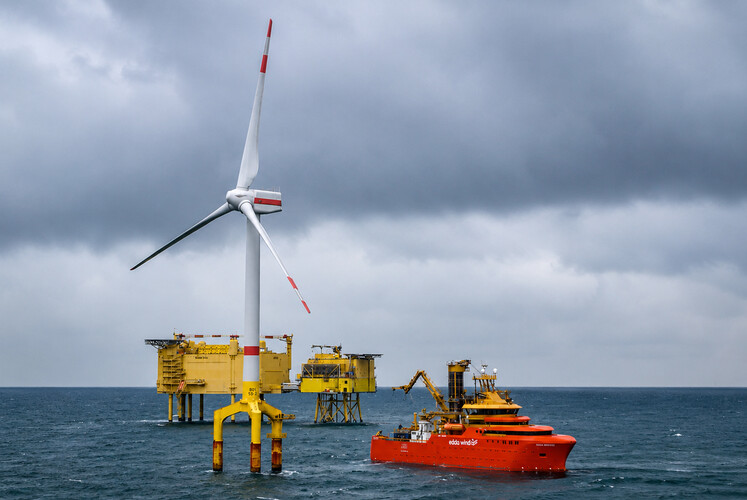
Offshore substations (OSS) are today no longer exclusively energy-technical infrastructure. Numerous projects show that these platforms have helidecks and thus function as a direct interface to aviation.
In addition, specially developed systems for helicopter refueling on offshore installations exist, intended in particular for larger installations and longer-lasting operations.
As a result, the OSS is increasingly developing into a multifunctional node with the following tasks:
- Energy transmission
- Technical operations
- Logistical supply
- Support of aviation operations
A central component here is the planning, assessment and inspection of helidecks as well as the integration of aviation-specific systems such as lighting, refueling facilities and safety areas in accordance with international standards.
4. Increasing Range and New Requirements for Helicopter Operations
As the distance of the wind farms grows, the requirements for range and operational safety increase considerably. The challenge lies in maintaining safe and economical operations under increasing offshore distances.
The development of high-performance helicopters as well as the integration of offshore infrastructure such as refueling possibilities represent key solution approaches. This leads to a transformation from isolated deployments to structured offshore air transport networks.
Specialised aviation service providers support this with the selection of suitable helicopter types, the development of deployment concepts and the optimization of offshore operating structures, particularly for long-range operations.
5. Remote Inspections of Helicopter Hoist Areas (HHA)
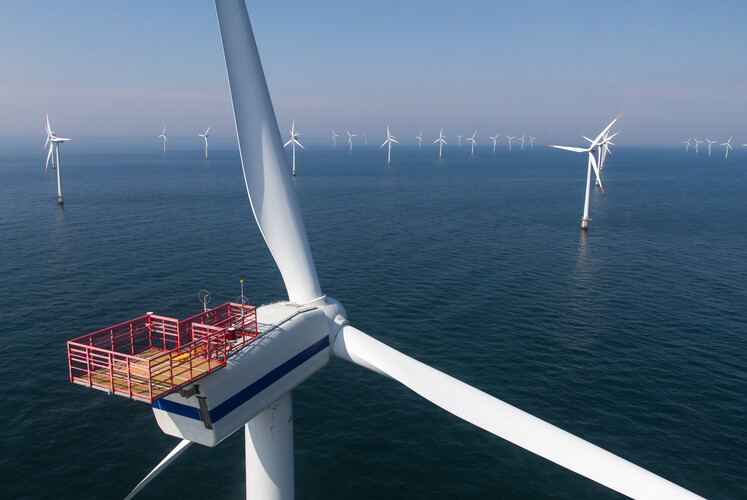
With increasing offshore distance and rising requirements for efficiency and safety, remotely conducted inspection procedures for helicopter hoist areas (HHA) are becoming increasingly important. These are inspections in which relevant technical conditions of the winching operation areas - for example surface condition, markings or obstacle situations - are assessed remotely on the basis of video, image and sensor data, without inspection personnel having to be physically deployed on the installation.
Particularly in the case of offshore installations that are difficult to access or under restricted weather conditions, such procedures enable a more flexible and faster condition assessment, thereby reducing downtime and minimizing operational risks.
The development and implementation of such inspection concepts is accompanied by specialized providers who ensure both methodological standards and regulatory requirements and integrate them into existing operating processes.
5.1 Methodological Approach
Remote inspections are based on the evaluation of:
- high-resolution image and video data
- live transmissions from camera systems
- digital documentation in accordance with aviation regulatory requirements
In this process, the relevant areas of the winching operation area, such as surface condition, markings, obstacles and safety clearances, are systematically recorded visually and documented according to defined inspection criteria. Through live transmissions, inspectors can specifically address individual aspects, request additional perspectives and actively control the inspection, comparable to an on-site inspection.
The evaluation is then carried out by qualified inspectors without physical presence on the offshore installation. On the basis of the structured data collected, it is assessed whether the winching operation area meets the requirements for safe flight operations or whether restrictions or measures are required.
It is thereby ensured that remote inspections meet the same quality and safety requirements as physical inspections and can be integrated into existing compliance and documentation systems.
5.2 Advantages and Limitations
Its use enables in particular:
- Reduction of offshore deployments and transport effort
- Increased flexibility for short-notice assessments
- Conducting inspections under restricted accessibility
At the same time, limitations exist:
- safety-critical details cannot be fully checked remotely
- physical reference inspections remain necessary
- regulatory acceptance varies depending on the authority
Remote inspections are therefore to be understood as a valuable alternative for operators. However, it must be determined where they can be meaningfully carried out, and they require further regulatory elaboration.
Assessments of the applicability of these procedures as well as the development of hybrid inspection strategies that meaningfully combine remote and on-site inspections are provided in support.
5.3 Transferability to Further Offshore Inspections
The methodological approach can also be transferred to other areas of offshore infrastructure, particularly:
- Helideck inspections on OSS and platforms
- Visual condition assessments of offshore substations
- Inspection of safety-relevant markings and surfaces
- Additional audit support and documentation reviews in remote format
This creates an expanded inspection concept that supplements physical inspections and transfers them into a digital offshore operating model.
In this context, standardised inspection procedures are developed and applied to various types of offshore installations in order to ensure a consistent assessment across different asset classes.
6. Future Perspective: Offshore Hubs and Artificial Energy Islands
A particularly far-reaching development step is the concept of artificial energy islands in the North Sea, in particular the Danish approach of the so-called “North Sea Energy Island.”
This project envisages the construction of an artificial island about 100 km off the Danish coast, functioning as a central node for several offshore wind farms. The planned infrastructure initially includes the connection of several gigawatts of capacity and will be gradually expanded to significantly higher capacities.
The energy island is more than an electrical collection point. It is conceived as a multifunctional offshore platform that integrates various functions:
- Bundling and distribution of electricity from several wind farms
- Connection to international electricity grids
- Integration of additional technologies such as power-to-X
- Provision of logistical and operational infrastructure
From an aviation-specific point of view, this concept opens up a completely new dimension. The central challenge lies in operating this large structure as an integrated offshore node in which energy, infrastructure and transport systems are brought together.
For aviation, several new questions arise from this:
- Development of suitable approach and departure procedures
- Integration of helidecks and potential multiple operations
- Consideration of large obstacle structures in the airspace
- Coordination between different transport systems
What is particularly relevant is that the energy island, as a permanent offshore infrastructure, forms the basis for a new operating model; away from decentralized individual installations and toward centralized offshore hubs.
A key solution approach lies in the early involvement of aviation-specific planning in the development of such large-scale projects. This includes in particular:
- Aeronautical studies on airspace integration
- Development of integrated offshore aviation concepts
- Definition of standards for multiple helicopter operations
- Combination of energy and aviation planning
Even though concrete aviation-specific operating models for energy islands are not yet fully defined, the system logic clearly shows: energy islands will become future central aviation nodes in the offshore sector.
For these novel offshore structures, early integration of aviation-specific expertise is required in order to develop integrated aviation concepts, multi-platform operations and safe airspace structures.
7. Drone-Based Material Transport and Offshore Infrastructure
7.1 Role of Drone-Based Material Transport in the Offshore System
As offshore wind farms increase in size and distance, the requirements for efficient logistics solutions rise considerably. While helicopters and maritime means of transport continue to represent central elements, clear operational and economic limits become apparent, particularly in the case of small-volume and time-critical transports.
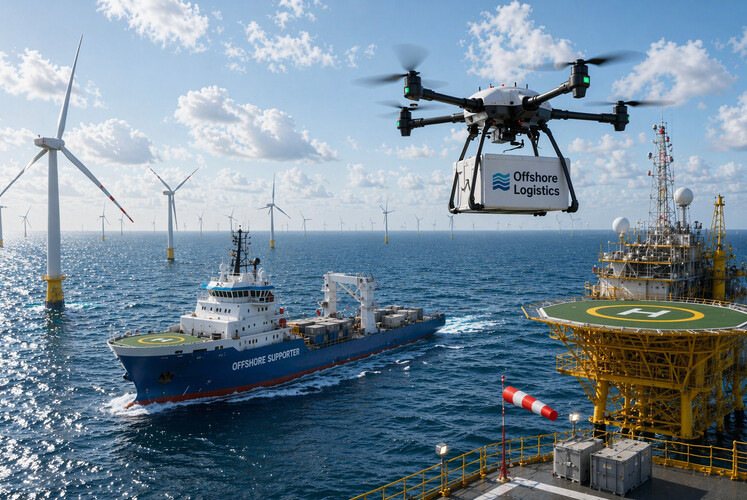
In this context, drones are developing into a supplementary transport solution for materials such as tools, spare parts and consumables. Initial applications show that both short-distance transport between vessels and installations and long-distance flights between the coast and offshore infrastructure are technically feasible.
The added value lies in particular in:
- Reduction of transport times and downtime costs
- Increase in operational flexibility
- Minimization of risks for personnel
Drones are therefore not a replacement, but an integral part of a hybrid offshore logistics system.
7.2 Infrastructure Requirements and Offshore Vertiports
Scaling drone operations requires the development of suitable infrastructure. Individual demonstration applications show that without standardized take-off and landing options, no sustainable integration into operations is possible.
In the offshore context, functional equivalents to vertiports are emerging that comprise the following elements:
- Landing and take-off areas on OSS, vessels or wind turbines
- Integration into existing platform infrastructure
- Energy and charging facilities
- Digital communication and control systems
In the future, specific offshore “droneports” will develop from this, functioning as logistical interfaces between air and offshore infrastructure. Studies show that dedicated landing platforms on wind turbines are also required for this purpose.
Compared with urban vertiports, these systems are:
- more compact and modular in design
- more strongly integrated into existing offshore structures
- designed for extreme environmental conditions
This creates a new infrastructure category within offshore aviation.
7.3 Necessity of New Procedures and Integration into Aviation
In addition to physical infrastructure, the development of new operating procedures is crucial for the safe and scalable use of drones.
Central requirements are:
- BVLOS operations for conducting long-distance flights
- Definition of flight corridors within offshore wind farms
- Integration into existing helicopter operations
- Coordination with maritime movements
The parallel use of airspace by manned and unmanned aircraft is already being tested and is fundamentally possible, but it requires clear regulations and coordinated procedures.
In addition, the following are required:
- automated mission and flight path planning
- continuous monitoring and control (e.g. telemetry)
- standardized emergency and contingency procedures
In the long term, integration into digital airspace management systems (e.g. U-Space) will be decisive for scalability.
This includes in particular the development of operating procedures, the definition of interfaces between manned and unmanned aviation, as well as integration into existing air transport and offshore systems.
8. Aviation Regulatory Implications
8.1 Integration of International Standards
Offshore flight operations are subject to a complex network of international and national regulations.
The challenge lies in their harmonized application to novel offshore structures.
One solution approach lies in the systematic transfer of existing regulations as well as their adaptation to offshore-specific framework conditions.
8.2 Increasing Complexity
The increasing density of wind farms leads to a significant tightening of requirements for flight planning and safety.
The challenge here lies in the assessment of complex obstacle structures and their influence on CNS systems and flight procedures. This requires comprehensive analyses and integrative planning approaches.
This process is supported by specialized consulting services that analyze regulatory requirements, translate them into project-specific solutions and accompany coordination with authorities.
9. Conclusion: Convergence of the Energy and Aviation Sectors
Offshore wind energy is driving a profound transformation of aviation in the maritime environment. Drone-based material transport represents a logical further development of offshore logistics. Successful implementation depends to a large extent on the parallel development of infrastructure and operating procedures.
In particular, offshore vertiports and standardized flight procedures form the basis for future system integration in which drones assume a fixed role within complex offshore aviation networks.
The most important developments can be summarized as follows:
- Spatial planning decisively determines aviation requirements
- Offshore infrastructure is becoming increasingly multifunctional
- Aviation is becoming a system-critical component
The central challenge lies in integrating these complex systems under increasing technical and regulatory requirements.
At the same time, clear solution approaches can be seen in early planning, the application of specialized expertise and continuous technical support.
This gives rise to a new offshore system in which energy, logistics and aviation are inseparably linked and helicopter operations assume a central role for efficiency and safety.
Companies with comprehensive expertise in aviation, regulation and offshore infrastructure, such as airsight, make a significant contribution here to the safe, efficient and compliant implementation of these complex systems.
Key Facts