Safety Assessment of Approach Lighting Systems at Copenhagen Airports
Copenhagen Airports

Copenhagen Airports operates two interconnected aerodromes with different roles and traffic profiles. Kastrup (EKCH) is a major international hub and Denmark’s largest airport, while Roskilde (EKRK) is a general aviation airport serving as a relief airport for EKCH and the country’s second-busiest airport in terms of annual movements.
Across both locations, Approach Lighting Systems (ALS) support instrument approaches, from ILS CAT I to CAT III operations. These systems exhibit several non-compliances such as non standard barrette types, and irregular spacing of individual light elements. Some ALS are also shorter than the standard length of 900 m.
To understand whether these deviations have any influence on operational safety, Copenhagen Airports engaged airsight to carry out a safety assessment covering ten ALS equipped runway directions. The focus was to review the non‑compliances, understand their operational relevance, and evaluate whether they affect pilots’ ability to identify and use the ALS during approaches.
airsight’s Assessment Approach
- Regulatory Review: Each ALS configuration was compared against the relevant provisions of EASA CS ADR DSN and supporting guidance. The aim was to document existing deviations, while understanding which arise from local physical or infrastructural constraints. The analysis incorporated a structured application of tolerances, including EASA and ICAO ALS tolerance provisions and dimensioning tolerances. This was supplemented by airsight’s project specific methodology, grounded in industry experience and best practice, to ensure focus on credible, safety relevant deviations.
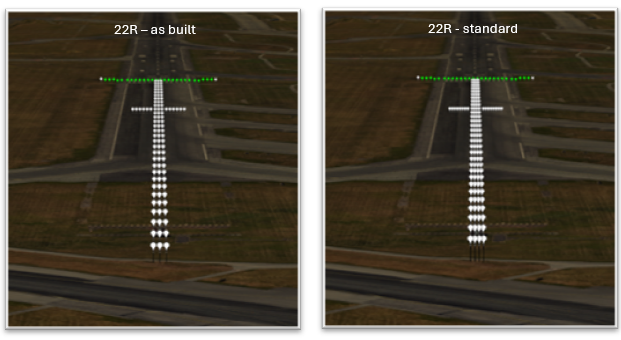
- Operational Analysis: Using 3D modelling and cockpit simulations, airsight examined how pilots perceive the ALS at DH/MDH across different approach types and visibility conditions. Comparisons were made between the as-built configuration, a fully compliant ideal arrangement, and additionally a scenario with maximum applied tolerances to understand how the identified deviations could influence ALS identification and runway alignment.
- Safety Assessment: The findings from the regulatory review and operational analysis, i.e. the identified non-compliances and simulated overall ALS performance, were then brought into a structured hazard identification and safety assessment process following the ICAO SMM principles. This stage focused on ALS recognition, clarity of visual cues, and their potential influence on pilot decision making during approaches, including the likelihood of misalignment, delayed recognition, or missed approaches.
Assessment Findings
The study confirmed that, despite non-standard features, the ALS installations at both EKCH and EKRK continue to provide their guidance function. Pilots are able to recognise the ALS patterns at the expected points of the approach, and the overall risk tolerability associated with ALS identification at DH/MDH was assessed as acceptable.
At the same time, even systems operating with an acceptable level of risk present opportunities for targeted improvement, many of which are common across aerodromes with long-serving visual aids infrastructure, such as:
- AIP Alignment: By reviewing published aeronautical information alongside on‑site configurations, airsight identifies inconsistencies and supports airports in keeping their AIP accurate and clear.
- Documentation Quality: As infrastructure evolves over time, retaining consistent and complete as‑built documentation can be challenging. By validating inputs, e.g. against available public datasets, airsight’s assessments can highlight where the documentation may be incomplete or outdated. Strengthening documentation helps airports maintain an accurate reference and supports future upgrade projects or maintenance planning.
- Improving ALS Configuration: airsight supports airports through infrastructure compliance checks and safety assessment to identify where the application of regulatory tolerances or targeted infrastructure updates can enhance performance without requiring major redesigns.
Why airsight
airsight has extensive experience assessing non‑standard and legacy aerodrome visual‑aids infrastructure. Our approach is based on a clear understanding and modelling of the system, careful validation of available data, and a safety‑focused review of operational relevance. We identify the practical implications for pilots and airport operators, helping airports maintain safe operations while planning any future updates based on real needs.
Contact Us
Planning an upgrade of approach lighting systems? Need support aligning visual aids with ICAO/EASA requirements? From compliance checks and operational reviews to safety assessments, airsight can support you with clear assessments and practical guidance.
Key Facts