Reducing Ambiguity on the Ground
Copenhagen Airport, Melbourne Airport

Summary
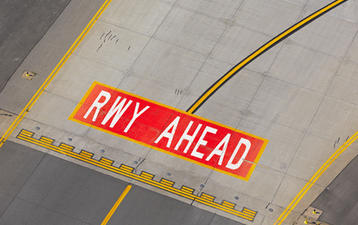
Clear and consistent visual aids and intuitive naming conventions are essential for safe and efficient airport operations. These elements play a critical role in reducing cognitive load for pilots and ground personnel, particularly under time pressure or low-visibility.
At any time, and especially during infrastructure changes such as taxiway renaming or apron expansions, any inconsistencies or complexities in movement area nomenclature and visual aids can lead to confusion, hesitation, increased need for radio clarifications, and routing errors. Further consequences often include operational delays and heightened safety risks.
While compliance of airfield designators and visual aids is a baseline, meeting regulatory requirements alone may not be sufficient guarantee of clarity or safety. Operational complexity, human factors, and evolving occurrence patterns can reveal risks that require reactive reviews – even outside major infrastructure changes.
airsight supported Melbourne and Copenhagen airports through comprehensive reviews of manoeuvring area visual aids and future-proof movement area naming evaluations, delivering practical, scalable improvements while minimising operational disruption.
Context & Challenges
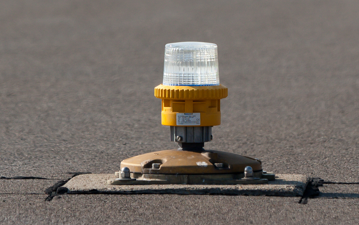
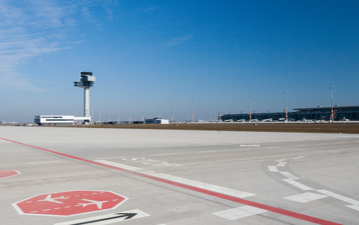
Modern aerodromes evolve continuously: terminals expand, new stands open, and taxiway networks grow and adapt as capacity and fleet mix change. With each change, the designation system (for taxiways, taxilanes, stands, holding positions) and visual aids (signs, markings, lights) must remain unambiguous in all conditions.
The challenge: Align with ICAO standards (including Annex 14), EASA Certification Specifications, and local regulations, while applying available guidance and best practices to bridge gaps where standards are less prescriptive (often the case for naming schemes). Solutions should preserve navigation clarity, support future growth, and fit around day-to-day operations without causing later costly reworks.

Our Approach
At Melbourne Airport, which is undergoing major runway and taxiway expansion and associated taxiway renaming, airsight assessed 50+ intersections and 170+ signs focusing on compliance, navigational adequacy, and future expansion. At Copenhagen Kastrup Airport, airsight supported a full aircraft stand renaming initiative to eliminate designation overlaps and establish an intuitive, growth-ready naming scheme.
airsight addressed these challenges through comprehensive review method including:
Regulatory Review: Review against international and local provisions to ensure conformity and guidance application, with consideration of site-specific constraints.
Operational Analysis: Validation against local traffic flows, ATC phraseology, procedures and practices to reduce ambiguity at complex intersections, busy piers, hotspots and communication handover points. We account for master plans and likely expansions (potential new infrastructure and taxi routes), so choices made today don’t force expensive, disruptive changes tomorrow.
Benchmarking & Best Practices: Comparison of designation logic with similar international airports and industry best practices to identify proven patterns and avoid pitfalls.
Advanced Visualisation & Simulation:
- 2D layout checks for consistency and regulatory alignment.
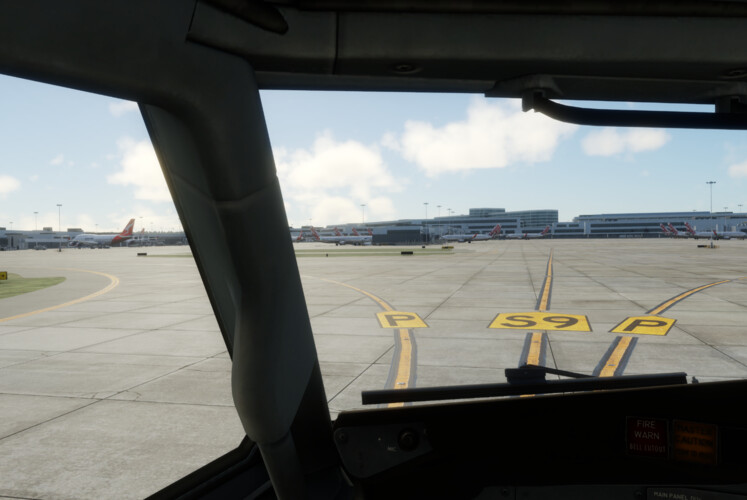
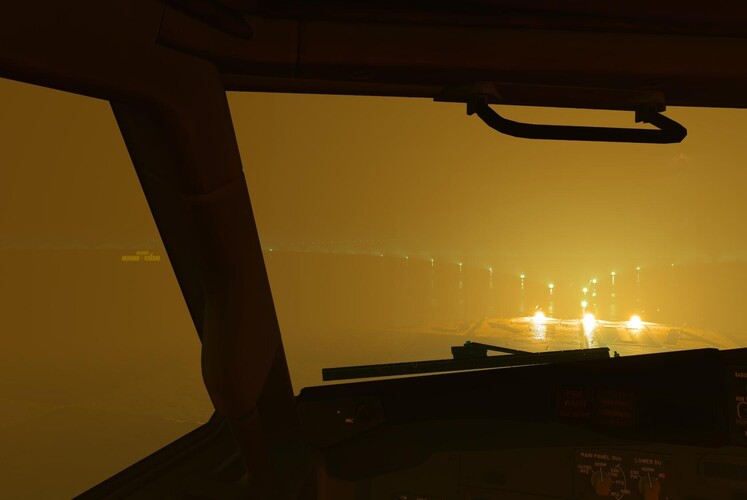
- 3D cockpit point-of-view simulations to confirm legibility, placement, and usability before investing in new signage or extensive remarking.
Human Factors & Radio Clarity: Human performance is central: the goal is to improve airfield intelligibility on the ground, on charts, and over the radio. We assess mental mapping, pattern recognition, and linguistic aspects, screening for look‑alike and sound‑alike risks to ensure intuitive naming for ATC, pilots, and vehicle drivers. This minimises misinterpretation across languages and reduces the chance of mishearing over radio or misreading in the cockpit.
Stakeholder Engagement: Focused workshops to ensure solutions are practical, accepted by relevant stakeholders, and aligned with implementation schedules.
Outcome
We deliver targeted services such as:
Visual Aids Assessment: Compliance checks and ground navigation quality reviews using 2D visualisations and cockpit POV 3D simulations.
Naming Convention Advisory: Criteria design, benchmarking, and master plan integration pathways.
Implementation Support: Change management principles, training focus, and phased roadmaps synchronized with ongoing projects to avoid disruption.
Results include targeted upgrade programs for signs, markings and lights and coherent naming frameworks that improve navigation clarity, reduce ambiguity, and support growth. Where multiple options exist, we apply multi‑criteria evaluation (e.g., comparing scalability, implementation effort) to select the most effective solution.
Why airsight
By combining regulatory expertise, operational experience, human factors engineering, and advanced simulation capability, airsight provides solutions that are compliant, intuitive, and growth‑ready. Our teams have supported airports worldwide through renaming programs, apron developments, and complex taxiway reconfigurations, always with safety and operations at the core.
Contact Us
Planning a taxiway renaming, apron expansion, or stand designation refresh? Experiencing safety events such as runway or taxiway incursions linked to ground navigation quality? We’ll help you reduce ambiguity, accelerate improvements, and prepare your layout for the future, all while minimising disruption to live operations.
Get in touch to discuss a tailored review or learn how our simulation-supported method can support safe, compliant, and cost-effective ground navigation enhancements.
Key Facts