Sustainable Aviation Fuels for Airports: Fundamentals and Implementation

Sustainable Aviation Fuel is no longer a future concept; it is a present obligation. EU ReFuelEU Aviation mandates are live, ICAO CORSIA SAF eligibility rules are in force, and airlines worldwide are under mounting pressure from investors, regulators and corporate customers to demonstrate credible SAF offtake. This two-day practical course is tailored to aviation professionals who need to move from SAF awareness to SAF implementation. It bridges the full learning journey from SAF definitions, ASTM standards, production pathways, feedstocks, lifecycle emissions, certification and regulatory requirements under ReFuelEU Aviation and CORSIA to airport infrastructure, blending operations, quality control, procurement models, pricing, book-and-claim accounting and transition planning.
Designed for airport operators, airlines, fuel suppliers and energy companies, the course focuses on the key functions responsible for making SAF work in practice: fuel operations, procurement, sustainability, environmental affairs and infrastructure or operations engineering. Participants will gain the knowledge and tools required to support SAF sourcing, account for its carbon benefits, integrate SAF into airport operations and bring airport-level implementation to well-to-pump readiness. A dedicated case study on building a SAF transition plan for an airport and a hands-on RFP simulation allow participants to apply the course content to realistic sourcing, infrastructure and implementation decisions. The course also provides an outlook on emerging SAF mandates and policy approaches worldwide, including developments such as the UK SAF Mandate, US incentive schemes, Singapore’s SAF requirement, Japan’s 2030 SAF target and other regional roadmaps that are shaping future fuel procurement and airport readiness.
 Training 5 or more people? Ask for an In-house course at your premises or online!
Course Details
Location:In-houseLanguage:German / English
Duration:2 days
Provider:airsight GmbH
Course Content
Day 1 // SAF Technology and Regulation
- What is SAF? Definition, ASTM D7566 standards and blending limits
- Production pathways: HEFA, Alcohol-to-Jet (AtJ), Fischer-Tropsch, Power-to-Liquid
- Feedstocks: used cooking oil, agricultural residues, green hydrogen, municipal waste
- Lifecycle carbon accounting: well-to-wake emissions methodology
- Certification and sustainability criteria: ISCC and RSB
- EU ReFuelEU Aviation Regulation: obligations for fuel suppliers and airports
- ICAO CORSIA eligibility criteria for SAF
- Outlook on SAF mandates and policy approaches worldwide, e.g. UK SAF Mandate, US incentive schemes, Singapore’s SAF requirement, Japan’s 2030 SAF target and other regional roadmaps
Day 2 // SAF Operations, Procurement and Finance
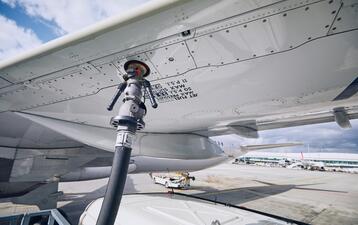
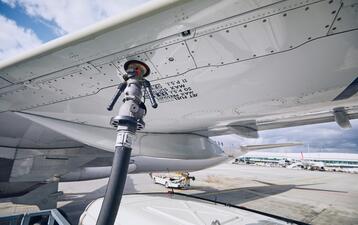
- Airport fueling infrastructure and implementation: single tank vs. dedicated SAF infrastructure
- Blending operations and quality control at airports
- Book-and-claim accounting framework (IATA SAF Registry)
- SAF procurement models: bilateral offtakes, consortia and power purchase structures
- SAF pricing: cost drivers, subsidies and price trajectories
- Airline demand signaling and the corporate SAF buyer landscape
- Case study: building a SAF transition plan for an airport
- Group exercise: SAF Request for Proposals (RFP) simulation
Trainer
Christoph Struempfel-Seifert, M.Sc.
Head of airsight’s Sustainable Aviation department
Mr Struempfel-Seifert is an expert for sustainable aviation and is responsible for all project tasks related to sustainable aviation and environmental protection at airports. Furthermore, he is an appreciated trainer, sharing his knowledge and practical experience with other national and international aviation experts.
After graduating as Master of Science in Aeronautics and Astronautics from the Technical University of Berlin, he worked as a research assistant and lecturer at the Chair of Flight Guidance and Air Transport at the TU Berlin. In his scientific career, he focused on modelling aircraft noise and emissions, UAS noise measurements and calculation as well as the optimization of flight procedures with respect to environmental and eco-efficiency targets.
For airsight, he has conducted several environmental assessments, noise and emissions studies for various airports in Germany, Luxembourg, United Arab Emirates, Romania and the Philippines. As a recognized SME for aircraft noise modeling, he has extensive experience with the FAA's Aviation Environmental Design Tool (AEDT).
A second major focus of his work is to support international airports on their decarbonization journey with detailed studies on renewable energy, in particular the implementation of solar energy systems, including Singapore-Changi, Berlin, Cologne, Düsseldorf, Stuttgart and various other airports. His team is helping airports meet the challenges of the future through new, sustainable technologies, such as sustainable aircraft taxiing and e-GSE implementation.
Robert Marx, M.Sc., MBA
Robert Marx is an aerospace engineer and sustainability advocate dedicated to shaping the future of aviation.
With a background in aeronautics and astronautics from the Technische Universität Berlin and an MBA from the University of St. Gallen and Imperial College London, where he focused on sustainable business strategy, he combines deep technical expertise with a strategic approach to implementation.
Robert has gained valuable experience working with industry leaders such as Lufthansa Cargo in Singapore and Boeing’s Future Aircraft Manufacturing Business Unit in Seattle and Puebla. These experiences not only broadened his perspective on the aviation sector but also reinforced the urgency of making air travel more sustainable.
In 2021, he founded the Sustainable Aviation Initiative e.V. (SAI) in Berlin, a non-profit organization dedicated to educating young professionals and fostering collaboration to accelerate aviation’s sustainable transition. SAI has developed an accredited university module on sustainability in aerospace at the University of Stuttgart, covering alternative propulsion systems, sustainable aviation fuels, and regulatory frameworks. The organization also produces the What’s Up Aviation podcast and hosts webinars, bringing together experts to discuss the latest advancements in the field.
Beyond SAI, Robert is passionate about mentoring startups and helping bridge the gap between innovative ideas and real-world application. His work is driven by a clear goal: to push the aviation industry toward more sustainable solutions without compromising its efficiency and connectivity.
Target Group
- Engineers and Planners
- Analysts
- Architects and Civil Engineers
- Regulators
- Operations Managers
- Non-aviation Personnel
- Accountable Managers
Organisational Details
airsight offers this training course on request, worldwide. At the end of the course, all participants will receive an airsight certificate based on EASA training regulations, which is highly recognised throughout the aviation industry.
About airsight Training

airsight Training course quality
airsight operates an ISO 9001 certified Quality Management System and pursues the objective to provide high quality services that fully meet the clients’ needs.