Safeguarding VFR Routes: Protecting General Aviation against Obstacles

Urban development and renewable energy initiatives have led to a rise in proposed structures near aerodromes — such as towers, masts, and wind turbines. These developments may have an impact on the safety and regularity of aircraft operations, incl. visual circuit patterns and VFR routes.
While pilots are ultimately responsible for obstacle clearance during VFR flights, the increasing complexity of airspace and the need to simultaneously aviate, navigate, and communicate can lead to cognitive overload. Therefore, just as IFR (Instrument Flight Rules) routes are protected, VFR routes also require both lateral and vertical safeguarding.
The basic Standardised European Rules of the Air (SERA) minimum requirements provide obstacle clearance requirements: Except when necessary for take-off or landing, a VFR flight shall not be flown at a height less than 150 m (500 ft) above the highest obstacle within a radius of 150 m (500 ft) from the aircraft.
The SERA minimum requirements, however, may be insufficient for the lateral protection of routes against high-rising developments. Additionally, neither the International Civil Aviation Organization (ICAO) nor the European Union Aviation Safety Agency (EASA) specify specific criteria for the protection of VFR routes. For example, on VFR routes opposite traffic may be present and turnarounds may need to be performed in specific low visibility scenarios.
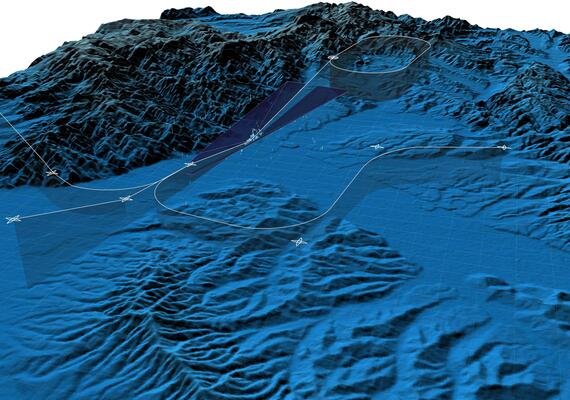
To address this regulatory deficiency, airsight conducted an aeronautical study to develop protection areas for VFR routes. The goal was to ensure that future developments near these routes do not render them unsafe or unusable.
In this regard, airsight has long supported airports and aviation authorities by assessing the impact of obstacles on flight operations. This includes evaluating both new and existing structures to ensure continued aviation safety.
To define an effective protection area, airsight first identified typical manoeuvres performed by VFR aircraft. For each manoeuvre the required distances and obstacle protection were calculated based on relevant altitude, aircraft airspeed and angle of bank.
After establishing a theoretical lateral protection area (semi-width) on either side of the VFR route centreline, airsight validated these dimensions using historical flight track data. This analysis focused on:
Validating aircraft speeds by assessing the aircraft categories operating on VFR routes.
Evaluating how accurately pilots followed the route centreline across different segments, including straight and curved segments as well as these with strong or poor visual reference cues.
Assessing the angle of bank used by pilots during 180° turns or orbiting manoeuvres (360° turns).
The analysis revealed that greater deviations were observed on routes with limited visual references and in complex segments involving tight turns. Pilots tended to favour straighter paths, intentionally deviating from the centreline. This indicates that VFR routes should be generally aligned with prominent visual landmarks (e.g. highways, railways, rivers) to support more consistent navigation.
Regardless, it can be expected that pilots will maintain more precise navigation along VFR routes when required (especially in obstacle-rich environments) provided they have sufficient situational awareness. This can be supported by formally documenting the protection areas in the Aeronautical Information Publication (AIP).
Ultimately, the analysis confirmed that the theoretically defined protection areas are appropriate and sufficiently dimensioned based on actual flight track data.
Facing safeguarding or obstacle challenges? We are here to help.
Whether related to VFR routes, visual circuit patterns or complex obstacle environments around aerodromes – airsight brings long-standing experience in aerodrome safeguarding, obstacle assessment and aeronautical studies such as this one. Our dedicated team of safeguarding and obstacle experts supports airports, authorities and operators worldwide in developing safe, practical and regulation-compliant solutions. Get in touch with us via e-mail or learn more about our Aerodrome Safeguarding & Obstacle Assessment services here.
Key Facts